Learn Boxing at Home
(The Right Way for Beginners)
Learning boxing at home can feel overwhelming — especially if you don’t have a coach watching you every day.
- Am I doing this right?
- Am I building bad habits?
- What should I actually be working on first?
You might be asking yourself:
If your goal is to learn real boxing at home, not just throw punches and sweat, you’re in the right place.
This page will show you how boxing should be learned, step by step, with a fundamentals-first approach that builds skill, confidence, and boxing IQ from day one.

The lessons I'm about to teach you have turned beginning boxers into state, regional, and national champions and professional boxers who have competed all over the United States and World.
The Biggest Mistake Beginners Make When Learning Boxing at Home
Most beginners make the same mistake:
They copy professional fighters they see on TV.
You see pros with their hands down.
You see flashy combinations.
You see speed, power, and creativity.
What you don’t see is:
- The years of fundamentals behind those movements
- The traps being set
- The counters already planned
- The distance, timing, and range awareness
Beginners must not train like professionals.
They must train like beginners and focus on building a solid foundation of fundamentals.
The One Technical Truth Every Beginner Must Understand
If you only learn one technical truth about boxing, it should be this:
There is a counter for everything in boxing.
Every punch has an opening.
Every defense creates offense.
Every mistake can be punished.
Understanding this forces you to think:
- What happens if I throw this punch?
- Where am I open?
- What could my opponent counter with?
This mindset builds boxing IQ, which is the greatest advantage any fighter can develop.
Smart fighters don’t win because they hit harder.
They win because they see more, think faster, and make better decisions.
Non-Negotiable Fundamentals Beginners Must Learn First
Before speed.
Before power.
Before combinations.
You must master these fundamentals.
1. Proper Stance and Balance
Your stance keeps you:
- On balance
- Protected
- Ready to attack or defend
If you’re off balance, you’re vulnerable — even if you’re athletic.
2. Walking the Ring (Foundation Footwork Drill)
Walking the ring teaches you how to move correctly in every direction:
- Step forward: push off the back foot
- Step back: push off the lead foot
- Step right: push off the left foot
- Step left: push off the right foot
This drill:
- Keeps your feet under you
- Prevents crossing your feet
- Builds balance and positioning
Even elite professionals should still practice this drill.
3. Lateral Movement (Dancing Circles)
You must learn to:
- Circle left
- Circle right
- Stay balanced while moving laterally
This builds:
- Ring control
- Defensive positioning
- Ability to escape pressure
Later, this drill connects to defensive movements like ducking under hooks while changing direction.
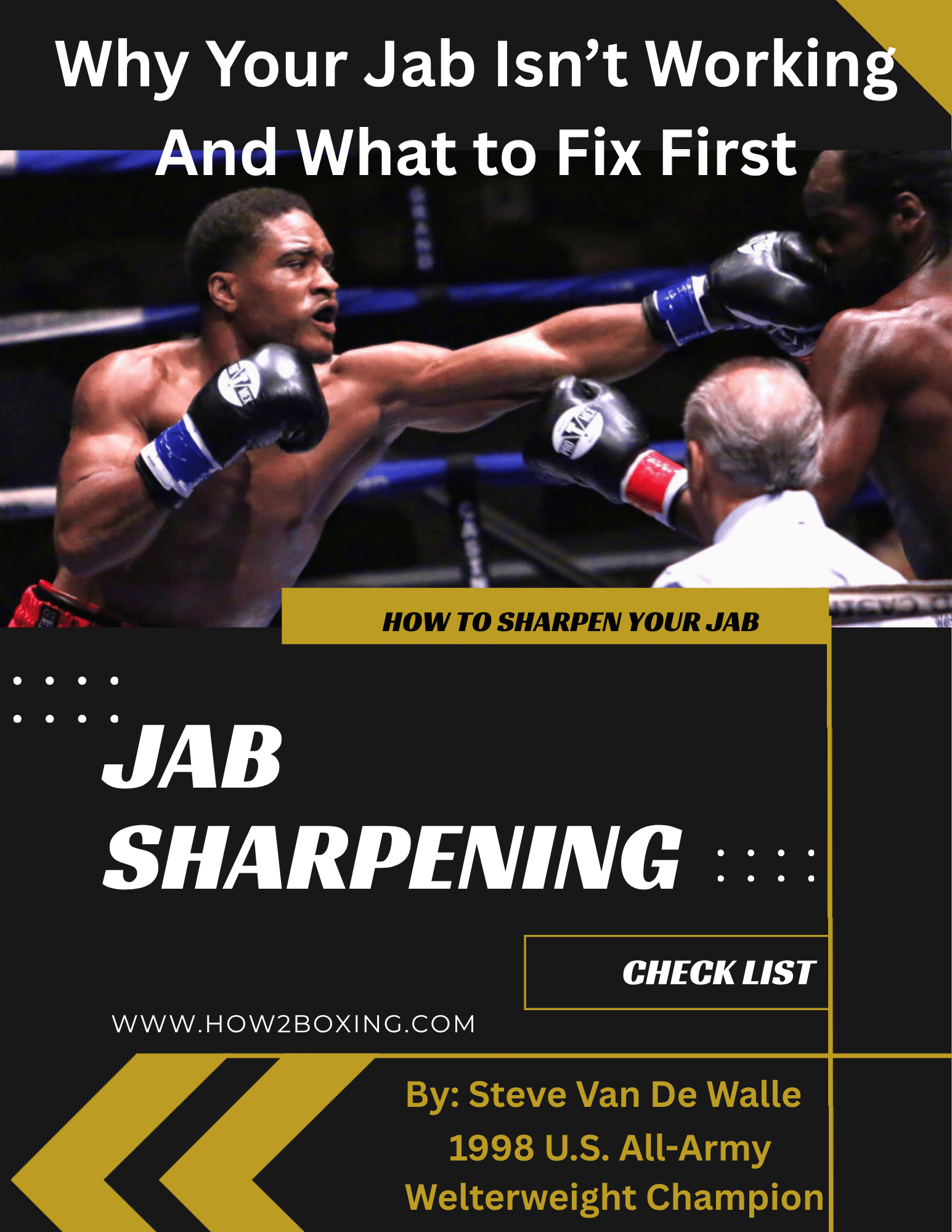
4. The Jab (Your Most Important Punch)Look over the lead hand
The jab:
- Establishes distance and range
- Sets up every other punch
- Stops opponents from attacking
- Protects you defensively
Most boxers say the jab is important.
Very few train like it is.
You must learn to:
- Step in off the back foot
- Keep the elbow down
- Protect your chin
5. Basic Defense (Before Combinations)
Defense is not optional.
Beginners should start by learning:
- Blocking the jab
- Parrying the jab
- Slipping the jab
- Pulling out of range
Defense sets up offense.
Always.
How to Structure a Complete At-Home Boxing Workout
Every great at-home boxing workout should include these elements:
1. Footwork Rounds2. Shadowboxing Rounds
- Walking the ring
- Dancing circles
Shadowboxing is not a warm-up.
It is skill refinement.
Imagine a real opponent.
Work with intention.
Focus on jab offense and jab defense.
3. Defensive RoundsPhone booth–style defense drills
- Slipping
- Blocking
- Parrying
- Bobbing and weaving
4. Conditioning RoundsConfidence
If you have equipment:
- Heavy bag
- Jump rope
If you don’t:
- High-intensity shadowboxing
- Boxing-specific conditioning drills
Conditioning builds:
- Endurance
- Mental toughness
5. Boxing-Specific Calisthenics
Strengthen:
- Neck
- Core
- Legs
- Feet
- Hands
This protects your body and supports your technique.
6. Flexibility Training
Often skipped.
Always critical.
Flexibility improves:
- Athleticism
- Longevity
- Movement quality
7. Mental Training Calm under pressure
Finish with:
- Visualization
- Breathing
- Meditation
This builds:
- Focus
- Self-awareness
What to Focus on Instead of Speed or Power
Speed and power come after fundamentals.
If you rush:
- You build bad habits
- You limit your potential
- You lower your boxing IQ
Slow, correct, intentional training creates:
- Clean technique
- Confidence
- Long-term growth
The #1 Habit That Will Instantly Improve Your Training
Record yourself.
When you train alone:
- No coach is watching
- Mistakes go unnoticed
Recording allows you to:
- Spot openings
- Catch telegraphs
- Fix balance issues
- Raise your boxing IQ
You become your own coach.
The Real Fear Beginners Have (And Why It’s Normal)
Most beginners fear:
- Doing things wrong
- Building bad habits
- Not knowing what to work on
This page exists to remove that uncertainty.
Structure creates confidence.
Confidence creates progress.
What Kind of Boxer This Approach Creates
This approach builds:
- Technically sound boxers
- High boxing IQ
- Discipline and self-mastery
- Confidence that grows every session
Whether your goal is:
- Fitness
- Skill
- Competition
- Coaching others one day
This foundation prepares you to go as far as boxing can take you.
Final Thought
Boxing rewards patience.
Master the fundamentals.
Train with intention.
Build skill before speed.
If you do this, you won’t just learn boxing at home —
you’ll build something that lasts.